
Living in a homeowners’ association in the Florida Panhandle brings its share of headaches. Disputes over fines, fees, and architectural review committee denials can feel impossible to resolve.
Plenty of homeowners get stuck choosing between unfair penalties and expensive court battles that drag on for ages.
Florida law actually requires mediation before you can sue your HOA for most disputes. Mediation lets both sides negotiate with a neutral third party, avoiding the high costs and delays of court.
If you know how HOA mediation works in the Panhandle, you could save thousands in legal fees.
This process gives you a structured way to resolve issues related to property rules or enforcement without the stress of a courtroom showdown.
Key Takeaways
- Florida law requires mediation before most HOA lawsuits about fines, fees, and architectural decisions.
- Mediation is faster and cheaper than court, and still protects both sides legally.
- Good preparation and knowledge of the law help you achieve better results in mediation.
What Is HOA Mediation — And Why It’s Especially Important In The Florida Panhandle

HOA mediation gives homeowners and associations a way to sort out conflicts without ever stepping into a courtroom. In the Florida Panhandle, the mix of seasonal residents, coastal property quirks, and different community standards makes mediation even more valuable.
Typical HOA Disputes In The Region
The Panhandle has its own flavor of HOA conflicts, thanks to its beaches and changing population. Hurricane-related disputes pop up frequently, especially when folks disagree over storm repairs, insurance claims, or emergency assessments.
Architectural Review Committee (ARC) decisions often rile up residents in beachfront neighborhoods. Property owners might be denied deck expansions, pools, or exterior changes that don’t meet coastal building standards.
Vacation rental drama is a big one, too. Full-time residents and investment property owners clash over noise, parking, and rowdy guests during tourist season.
Common fine disputes include:
- Landscaping violations during hurricane season
- Boat and RV storage disagreements
- Beach access rule violations
- Pool and amenity usage conflicts
And then there’s the communication gap. Seasonal residents often miss updates about rule changes, assessments, or meetings because they’re away from their Panhandle homes.
Why Litigation Is Costly & Harmful To Community Relationships
Florida courts see thousands of HOA disputes every year. These legal battles can cost residents between $15,000 and $50,000 per side before anything gets settled.
Taking neighbors to court damages relationships, sometimes for good. People who fight in court often stay at odds for years, which makes HOA meetings and neighborhood events pretty awkward.
Delays are brutal in the Panhandle, too. Court cases can drag on for 18 to 36 months. Seasonal residents might not even be around for key dates, stretching things out even longer.
On top of that, lawsuits become public record. This can scare off buyers and hurt property values for everyone in the neighborhood.
The courtroom pushes people into extreme corners. Mediation offers a quicker, less expensive way out—and honestly, it’s usually less stressful for everyone.
When Fines, Fees & ARC Denials Trigger Mediation — Not Just Court

Florida law spells out what HOAs have to do before they fine you or deny your architectural requests.
Homeowners must try mediation before running to court. HOA fines can be enforced in Florida, but there are strict limits and hearing requirements to protect you.
Fines And Fees – Legal Cap, Hearing Requirements, Lien Thresholds
Florida Statute 720.305 caps fines at $100 per violation or $1,000 total for ongoing issues, unless your HOA’s rules say otherwise. HOAs can’t just slap on fines without following the proper steps.
The board sends a written notice first. You can request a hearing before any fine is added to your bill.
Required hearing steps:
- Written notice at least 14 days before the hearing
- Chance for you to speak up
- Right to bring witnesses or a representative
- Written decision in a reasonable time
Once fines reach certain thresholds, HOAs can place liens on your property. Usually, your community’s documents spell out when that happens.
If fines go over legal limits or the board skips the hearing, you can challenge them through mediation before things get out of hand. That move saves everyone time and money.
ARC Denials – Procedural Requirements For ARC Meetings And Decisions
Architectural Review Committees must follow established procedures when reviewing your requests. The HOA’s rules lay out the details, but Florida law sets the minimum bar.
ARC meetings usually require:
- Reasonable notice to you
- Written application steps
- Clear review criteria
- Timely decisions (typically 30-60 days)
- Written reasons for any denial
Committees can’t just say no for no reason. Their decisions have to connect to real community interests, like property values or maintaining a consistent look.
If you think the ARC denied your request unfairly, you can push for mandatory pre-suit mediation under Florida Statute 720.311.
Mediation lets both sides talk things out with a neutral third party—way before anyone racks up court bills.
Why The Florida Panhandle Boards & Homeowners Should Care
Mediation gives everyone a less hostile, more affordable option than court. HOAs and homeowners both get faster resolutions and avoid ugly legal fights.
Florida law penalizes anyone who refuses to mediate when required. Ignore mediation, and you can’t collect attorney’s fees in court—even if you win.
Benefits for Panhandle communities:
- Faster dispute resolution
- Lower legal costs
- Better relationships with neighbors
- Less risk for board members
Both sides split mediation costs under Florida Statute 720.311, so it doesn’t break the bank. The Florida Supreme Court maintains a list of certified mediators to ensure they’re qualified.
The Statutory Framework You Must Know (Chapter 720 & Others)
Florida law lays out specific steps before you can sue your HOA. Chapter 720 of the Florida Statutes requires you to try presuit mediation for most disputes over fines, fees, and architectural decisions.
Key Provisions: Demand Letter, 20-Day Response, Chosen Mediator, Costs
Florida Statute 720.311 requires you to send a demand for mediation first before you head to court. The homeowner has to send a written demand to the HOA board.
The HOA has 20 days to respond once it receives the letter. If they agree, the Mediation is to be held within 90 days of the date of the demand letter.
How mediator selection works:
- Both sides propose three mediators
- Each strikes one from the other’s list
- Pick from whoever’s left
- Mediator has to be Florida Supreme Court-certified
The person who starts mediation usually pays the filing fee. Both sides split the remaining mediation costs unless they agree otherwise.
If the HOA ignores the demand for 20 days, you can skip mediation and go straight to court. That’s the one shortcut.
Exemptions & When You May Bypass Mediation
Some disputes don’t need presuit mediation under Chapter 720. Emergencies that threaten safety get a pass.
Automatic exemptions include:
- Cases asking only for injunctive relief
- Disputes under $1,000 (small claims court)
- Emergency repairs that affect livability
- Fair housing law violations
If the HOA refused to mediate in good faith on the same issue within the last year, you can skip mediation. But you’ll need proof they acted in bad faith.
Signs of bad faith:
- Not showing up for scheduled sessions
- Refusing reasonable offers
- Sending someone without authority to settle
Application To Florida Panhandle HOAs
Every Florida HOA must comply with Chapter 720, regardless of its location. Panhandle HOAs in Escambia, Santa Rosa, and Okaloosa counties follow the same rules.
Local circuit courts in the Panhandle enforce these laws. The First Judicial Circuit covers most Panhandle counties and handles plenty of HOA mediation cases.
Panhandle-specific issues:
- Not many mediators in rural areas
- Travel costs can bump up the price
- Video mediation helps with distance
Many Panhandle HOAs have volunteer boards that may not know the mediation rules. If you’re a homeowner, spell out the statute in your demand letter to keep things clear.
The 20-day response rule applies to every Florida HOA, even the small ones scattered across the Panhandle.
Step-By-Step: How HOA Mediation Works In The Florida Panhandle
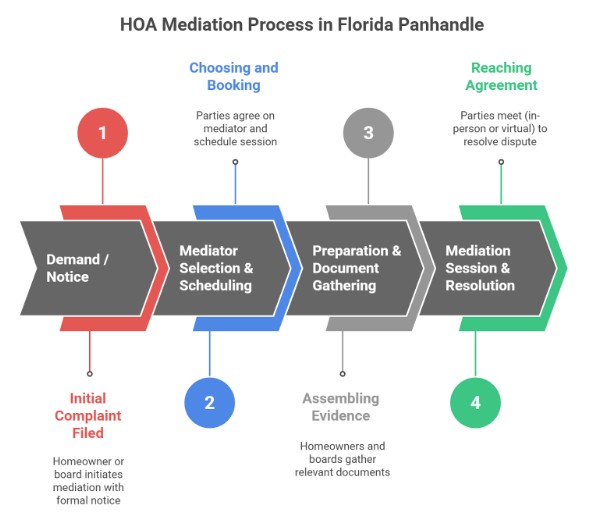
HOA mediation in the Florida Panhandle moves through a five-stage process. It starts with a formal notice and ends with binding settlement agreements.
This process usually takes about 60-90 days. You can do it in person or over Zoom, which is handy if you’re not local or just prefer virtual meetings.
Stage 1 – Demand / Notice
Either the homeowner or the HOA board initiates mediation by sending a written demand. Florida law requires mediation for some disputes before heading to court.
The demand letter needs to spell out the details—property address, names of everyone involved, and a clear explanation of what’s going on.
Required Information in Demand Letter:
- Date of the dispute
- Specific HOA rules or regulations in question
- Attempts were made to resolve the issue
- Contact information for all parties
The other party gets 20 days to respond. If they ignore it or say no, the person who sent the demand can take legal action.
Both sides should agree to participate in good faith. Show up ready to actually work toward a solution.
Stage 2 – Selecting The Mediator & Scheduling
Once everyone’s on board, the parties have 90 days to mediate. The mediator must be certified by the Florida Supreme Court as a circuit court civil mediator.
There are a few ways to choose someone. Both sides can agree on one; each can pick one, and let those two select a third; or they can ask a mediation group for a list.
Mediator Qualifications:
- Florida Supreme Court certification
- No conflicts of interest with either party
- Available within a reasonable timeframe
They need to schedule the session within 90 days of the original demand. Most sessions in the Panhandle happen within 30-45 days.
People meet at the mediator’s office, a community clubhouse, or online. Virtual mediation has really taken off since 2020.
Stage 3 – Preparation & Document Gathering (What Homeowners/Boards Bring)
Good prep makes a big difference. Homeowners and board members should collect all relevant paperwork at least a week before mediation.
Homeowners Should Bring:
- All correspondence with the HOA
- Photos or videos related to the dispute
- Receipts for any expenses incurred
- Copy of governing documents
- Property deed or closing documents
HOA Boards Should Bring:
- Meeting minutes discussing the issue
- Enforcement records and violation notices
- Architectural review committee decisions
- Financial records if fees are disputed
- Legal opinions or professional reports
Both sides should write up a short summary of their position. This helps the mediator get up to speed fast.
It’s smart to think about your bottom line before you walk in. What do you really need out of this? What can you let go of?
Stage 4 – Mediation Session & Resolution (Including Virtual/Zoom Options)
The mediation session usually takes 3-6 hours. The mediator starts by explaining the ground rules.
Joint sessions and individual meetings are both used to help parties come to a mutual agreement, based on the parties’ needs.
Virtual Mediation Process:
- Zoom or similar platform required
- Separate breakout rooms for private caucuses
- Document sharing through secure portals
- Same legal enforceability as in-person sessions
Most HOA disputes in the Panhandle settle in one session. More challenging cases with multiple issues or big money sometimes need more meetings.
The mediator can’t force a deal. Both sides have to agree to the outcome on their own terms.
What Happens After: Settlement Agreement, Enforcement
If there’s a deal, the mediator writes up a settlement agreement that day. Everyone signs before leaving.
These agreements are legally binding. If someone doesn’t follow through, the other side can enforce it in court.
Typical Settlement Terms:
- Payment schedules for fines or fees
- Compliance deadlines for violations
- Modification of HOA rules or enforcement
- Release of claims between parties
If mediation falls apart, either party can go to court or arbitration. Around 80% of HOA mediations actually settle, though.
The agreement should lay out deadlines and what happens if someone doesn’t comply. That way, you (hopefully) avoid future arguments over the same stuff.
Everyone should keep a copy of the signed agreement and any essential documents. The mediator keeps discussions confidential, but the final settlement terms aren’t secret.
Preparing For Mediation: Homeowner & HOA Board Checklists
Getting ready for mediation takes work. Homeowners and HOA boards need to pull together the right records and avoid mistakes that can hurt their chances.
Homeowner Checklist
Homeowners should start by collecting their community’s governing documents. That means the Declaration of Covenants, Conditions, and Restrictions (CC&Rs), bylaws, and ARC guidelines.
Essential Documents to Gather:
- Original violation notices and fine letters
- All email correspondence with the HOA
- Written responses to violation notices
- Property photos showing current conditions
- Receipts for any corrective work completed
Print out all emails, texts, and letters exchanged with board members or managers. Communication records are huge in mediation.
Take photos of your property before, during, and after any alleged violations. Add timestamps and different angles for clarity.
Keep a log of phone calls. Jot down dates, times, who you spoke with, and what you talked about. That timeline can be a lifesaver.
Financial Records Needed:
- Payment history for HOA dues
- Receipts for fines paid under protest
- Invoices for property improvements
- Bank statements showing payment attempts
HOA Board Checklist
HOA boards need to demonstrate they followed the rules before issuing fines or denying architectural requests. Documenting the hearing process is crucial.
Required Hearing Documentation:
- Written notice of violation sent to homeowner
- Proof of delivery (certified mail receipts)
- Minutes from board meetings discussing the violation
- Records of any hearings held
- Written decision letters explaining the outcome
The fine and fee ledger should show exactly what’s owed and any payments. Include interest, if any, and details of any payment plans.
ARC records need to be thorough—application files, meeting minutes, and denial letters with reasons should all be there.
Financial Documentation Needed:
- Detailed accounting of all fines imposed
- Records of collection efforts
- Bank deposits from homeowner payments
- Late fee calculations and supporting policies
Board members should double-check the governing documents to ensure they stayed within their authority and followed all required steps.
Mistakes To Avoid (Skipping Mediation, Ignoring Demand, Inadequate Documentation)
Florida law requires mediation for some HOA disputes before you can sue. Skipping it could mean you lose the right to recover attorney fees, even if you win in court later.
Ignoring a mediation demand can backfire, too. Homeowners who skip mediation may lose the right to recover attorney’s fees in court.
Common Documentation Mistakes:
- Incomplete violation notice records
- Missing certified mail receipts
- Unsigned board meeting minutes
- Informal text messages instead of written notices
Sloppy record-keeping weakens your position. Handwritten notes without dates or signatures don’t carry much weight compared to formal documents.
Try to keep emotions out of your prep. Stick to facts, dates, and policy violations—not personal gripes or personality clashes.
Benefits & Pitfalls Of Mediation In The Florida Panhandle
Mediation can save a lot of time and money in HOA disputes and keeps matters private. But you need good faith and solid prep for it to work.
Sometimes, though, litigation is unavoidable—knowing when to use mediation can save you a lot of headaches.
Benefits – Cost/Time Savings, Confidentiality, Creative Solutions
Mediation is way cheaper than litigation for HOA disputes in Florida. Most sessions cost $300-800 total, split between the parties. Court cases? Those can run $5,000-15,000 per side just in legal fees.
Time matters, too. Mediation usually wraps up in 30-90 days. Court can drag on for a year or two—sometimes longer.
Mediation stays private. No public records, no airing your dirty laundry. That helps protect property values and your community’s reputation.
Creative solutions can come out of mediation that courts just can’t order. For example:
- Payment plans for fines
- Modified architectural plans instead of flat denials
- Board policy changes to prevent future fights
- Phased timelines for compliance
Mediators try to help everyone find a win, not just pick a winner and a loser.
Pitfalls
Bad faith participation can kill mediation. Some boards show up with zero intention of negotiating and just want to gather info for the court.
Homeowners sometimes do the same—making wild demands or refusing to admit any fault. That doesn’t get anyone anywhere.
Incomplete prep wastes everyone’s time. Showing up without the right documents or authority to settle can mean extra sessions or no deal.
Common prep mistakes include:
- Missing ARC records
- Incomplete violation documentation
- No examples of similar fines
- No idea what settlement you’d accept
Non-binding agreements can cause headaches. Verbal deals made in mediation can’t be enforced. You need a well-written, signed settlement for it to stick.
If the settlement is vague or sloppy, you could end up right back where you started in a few months.
When You Should Consider Litigation Instead
Florida law requires arbitration, not mediation, for board recalls and election disputes.
Constitutional violations need court intervention.
Issues involving free speech, religious expression, or disability accommodation require legal precedent that mediation just can’t provide.
Pattern violations by boards may require litigation.
When boards keep ignoring governing documents or state law, only court orders create real, lasting change.
Consider litigation when:
- Mediation has already failed twice
- Opposing party refuses to attend mediation
- Emergency injunctive relief is needed
- Legal precedent must be established
Large assessment disputes or significant property damage claims may recover enough to offset legal expenses.
Time-sensitive matters, like foreclosure proceedings, may not be suitable for mediation due to their time-sensitive nature.
Fines, Fees & ARC Denials — And How Mediation Can Fix Them
HOAs in the Florida Panhandle often make procedural mistakes when issuing fines or denying architectural requests.
These errors create legal vulnerabilities that mediation can resolve more efficiently than drawn-out court battles.
Improper Fine Process (Notice/Hearing)
Florida law says HOAs have to follow specific steps before imposing fines on homeowners.
The association must provide written notice of the violation and offer a hearing opportunity.
Many HOAs skip the required notice period or fail to schedule hearings altogether.
Some boards issue fines immediately, without giving homeowners a chance to respond or fix the problem.
Common notice violations include:
- Sending notices less than 14 days before hearings
- Failing to specify the exact violation details
- Not providing copies of governing documents
- Missing certified mail requirements
The hearing process creates headaches, too.
Board members who voted to pursue the fine can’t participate in the hearing, but this trips up many smaller HOAs.
Mediation helps resolve fine disputes by addressing both the underlying violation and procedural slip-ups.
Homeowners can negotiate payment plans, while HOAs avoid costly legal fights over their own authority.
Lien/Fee Cap Violations By HOA
Florida caps certain HOA fees and restricts lien-filing procedures.
Associations that exceed these limits face legal exposure and potential damages to homeowners.
HOAs can charge reasonable fees for document preparation, but they can’t charge excessive amounts that discourage property sales.
Lien filing errors include:
- Filing liens for amounts under $1,000
- Missing required notice periods
- Including improper charges like attorney fees
- Failing to credit partial payments
Mediation lets everyone review fee calculations and correct overcharges.
HOAs can update their policies, and homeowners might get credits for improper charges.
ARC Denial Without Proper Standards/Meeting
Architectural Review Committees need to follow written guidelines when evaluating homeowner requests.
Denials without specific criteria create legal problems for associations.
Many HOAs reject applications based on personal preferences rather than published standards.
Board members might cite “community character” without actually defining what that means.
The approval process should include proper committee meetings and documentation.
Some associations make decisions through email chains or casual chats that lack real transparency.
ARC process violations include:
- No written denial reasons
- Inconsistent application of rules
- Missing committee meeting minutes
- Failure to cite specific covenant sections
Aesthetic preferences can’t override clear language in a governing document.
When HOAs approve similar requests for other homeowners, they set a precedent and open the door to discrimination claims.
Mediation addresses ARC denials by reviewing both the specific request and committee procedures.
Homeowners can tweak their plans, and HOAs can clarify future standards.
Board Treats Homeowner As “Exception” Rather Than Equal
Some HOA boards develop adversarial relationships with specific homeowners they see as troublemakers.
This leads to unequal enforcement and potential violations of fair housing laws.
Selective enforcement crops up when boards ignore similar violations by other residents but target specific individuals.
Documentation usually shows patterns of disparate treatment.
Board communications sometimes include personal attacks or dismissive language toward specific homeowners.
These records can become evidence in discrimination claims.
Signs of unequal treatment:
- Higher fines for the same violations
- Immediate enforcement without warnings
- Rejection of reasonable accommodation requests
- Personal comments in official correspondence
Some boards refuse to communicate directly with targeted homeowners and instead require all contact to go through property managers or attorneys.
Mediation provides neutral ground where both parties can finally address the underlying conflict.
Professional mediators help boards recognize fairness requirements and give homeowners an authentic voice in the discussion.
Unclear Settlement Terms Or Failure To Record Outcome
Dispute resolution often breaks down because parties don’t properly document agreements.
Vague settlement terms create new conflicts once implementation starts.
Payment plans need specific amounts, due dates, and default provisions.
General language like “reasonable monthly payments” just causes confusion and more disputes.
Modification agreements require precise specifications and approved timelines.
When homeowners make changes, both sides should sign off when everything’s done.
Essential settlement elements:
- Specific dollar amounts and dates
- Clear performance requirements
- Default and remedy procedures
- Board resolution adoption requirements
Some agreements ignore ongoing compliance monitoring.
Homeowners might think violations are permanently resolved, while HOAs expect continued oversight.
Recording requirements vary by agreement type.
Covenant modifications require formal documentation, while fine settlements may suffice with board minutes.
Professional mediation ensures proper documentation of all settlement terms.
Mediators help everyone spot potential implementation problems and create enforcement mechanisms that actually prevent future disputes.
Choosing The Right Mediator & Legal Support In The Florida Panhandle
Panhandle residents can go with local or remote mediators, and each option has its own quirks.
Attorneys provide valuable support during mediation and are essential for complex disputes.
Credentials & Experience To Look For
Florida requires mediators to be certified by the Florida Supreme Court.
This certification means they meet state training standards and follow ethical guidelines.
Essential Qualifications:
- Florida Supreme Court Certified Mediator status
- Active mediation practice (not just legal background)
- Knowledge of Florida HOA statutes
HOA disputes involve unique rules and regulations.
Mediators with community association experience understand issues such as architectural review committees, covenant enforcement, and assessment collection.
Selecting the right mediator can really impact your case outcome.
Experience with similar disputes helps mediators guide discussions more effectively.
Local Vs Remote Mediation – Pros & Cons For the Panhandle Region
The Florida Panhandle has fewer certified mediators than bigger cities.
This means you get to choose between local and remote options.
Local Mediation Benefits:
- Face-to-face interaction builds trust
- Mediator understands regional HOA practices
- No technology barriers
- Easier to schedule follow-up sessions
Remote Mediation Advantages:
- Access to specialized HOA mediators statewide
- Lower travel costs for all parties
- Flexible scheduling options
- Proven effective for document-heavy disputes
.
Remote mediation works well for minor disputes and rule violations.
But for complex construction defect cases, in-person sessions are better.
What To Do Right Now If You’re Facing Fines, Fees, Or ARC Denials
Act quickly and follow proper procedures to protect your rights when facing HOA violations.
Document everything, meet legal deadlines, and prep a strong case before stepping into mediation.
Review Your Violation/Fine Letter Or ARC Denial
Take a close look at every detail in your violation notice or ARC denial letter.
These documents hold critical information about deadlines and required responses.
Check these key elements:
- Violation date and specific rule cited
- Fine amount and payment deadline
- Appeal deadline (usually 14-30 days)
- Required response format
The HOA must follow specific criteria and processes for imposing fines.
They can’t issue fines without proper notice or hearing procedures.
Look for procedural errors in the notice.
Common mistakes include incorrect dates, wrong rule citations, or missing required language about appeal rights.
Document any errors right away.
Take photos of the alleged violation area and, if possible, gather witness statements.
Request Mediation Or Respond To Demand Within Statutory Timeframes
Florida law requires homeowners to respond within specific timeframes to maintain their rights. If you miss these deadlines, fines or denials may be automatically enforced.
Critical deadlines include:
| Action Required | Typical Timeframe |
| Fine Appeal | 14-30 days |
| ARC Decision Appeal | 30 days |
| Mediation Request | Before lawsuit filing |
Send your response in writing, ideally by certified mail. Make sure your letter clearly states you’re appealing the decision and want a hearing.
Mediation offers an alternative to court that could save time and money. Ask for mediation in your first response—this shows you’re acting in good faith, which never hurts.
Add a short explanation of why you think the fine or denial isn’t fair. This preserves your right to present more evidence later.
Collect And Organize Evidence
You’ll want solid evidence to support your position in mediation. Start by gathering all documents and proof before you walk in.
Essential evidence includes:
- Original violation notice and all correspondence
- Photos of property conditions (dated, if possible)
- Copies of HOA rules and documents
- Outcomes of previous, similar violations
- Witness statements from neighbors
- Professional reports or inspections
Make a timeline of events leading up to the violation or ARC denial. It’s amazing what you can spot when you see everything laid out—sometimes the HOA doesn’t even follow its own rules.
Take a close look at the HOA’s governing documents to see if the violation actually holds up. Some rules clash with state law or were never properly adopted.
Sort your materials in folders by category and date. A little organization goes a long way and shows you’re taking the process seriously.
Engage Mediator/Attorney And Prepare Proposals
Getting professional help can make a real difference. Attorneys who know HOA law spot details and arguments most people miss.
Local mediators know the area’s quirks and common issues.
Prep some settlement proposals before mediation:
- Payment plans for fines that are legit
- Reasonable timelines for fixing real violations
- Compromises on rule interpretations
- Ways to monitor ongoing compliance
Legal pros can challenge unfair fees or fines and know the best negotiation tactics. They’re worth considering if things get complicated.
Draft a few proposal options with different terms. Being flexible during mediation honestly boosts your odds of getting a deal done.
Practice explaining your case in a clear, factual way. Emotional arguments rarely work in mediation, even if you’re frustrated.
Implement Settlement & Ensure Monitoring
Mediation only works if both sides actually follow through. Everyone needs to know their obligations and stick to them.
Settlement agreements should spell out:
- Specific requirements and deadlines
- Payment schedules for any fines
- How you’ll communicate going forward
- What happens if someone doesn’t comply
Get the agreement in writing, signed by everyone involved. Verbal promises are tough to enforce if things go south later.
Set up a way to track compliance—photos of completed work are helpful. Keep records of all payments and communications after you settle.
This protects you from future disputes over the same issue. Check in with the HOA board to confirm they received your proof of compliance, and ask for written confirmation that it’s resolved.
Store settlement documents with your other property records. You never know when a future buyer or new HOA board member might ask for them.
Conclusion
Florida Panhandle homeowners dealing with HOA disputes have options. You don’t always need to go to court and rack up those legal bills.
Mediation offers a faster, more affordable way to resolve conflicts with community associations.
In mediation, both sides meet with a neutral third party to hash things out. This setup works well for fine disputes, ARC denials, and enforcement headaches.
Did you know Florida law requires mediation before filing lawsuits in many HOA conflicts? That’s because mediation actually solves most of these issues.
Homeowners need to prep for mediation. Bring documentation, communicate clearly, and know your HOA’s rules—these steps can really help your case.
Professional legal guidance during mediation makes a difference. Attorneys who know Florida HOA law can offer support and help you protect your rights.
Mediation saves time, money, and headaches. If you’re facing an HOA conflict in the Panhandle, it’s probably your best bet for keeping the peace and moving forward.
Frequently Asked Questions
What is HOA mediation in Florida, and when is it required?
HOA mediation in Florida is a pre-suit process where a neutral mediator helps homeowners and their HOA resolve disputes without going to court. Florida Statute § 720.311 requires mediation before filing a lawsuit in most covenant enforcement cases.
Does HOA mediation apply to fines, fees, and ARC denial disputes?
Yes. Disputes over HOA fines, unpaid fees, and ARC (Architectural Review Committee) denials fall under covenant enforcement and must usually go through mediation before
How long do you have to respond to an HOA mediation demand in Florida?
You have 20 days from the date a mediation demand is mailed to respond in writing.
What are the benefits of HOA mediation over litigation?
Mediation is faster, less expensive, and private. It preserves community relationships and allows flexible solutions, while litigation is slower, public, and more costly.
Can you skip HOA mediation and go straight to court in Florida?
No. If your dispute is covered by § 720.311, you must attempt mediation first. Skipping mediation can block recovery of attorney’s fees and may delay your case.
What does the HOA mediation process involve?
The process includes a written demand, a 20-day response, mediator selection, document preparation, and a mediation session. If the parties agree, a signed settlement agreement is enforceable.
How should homeowners or HOAs prepare for mediation?
Gather governing documents, violation notices, fee records, ARC applications, and photos. Know your rights under Chapter 720 and select a mediator experienced with Florida HOA disputes.